case study
HypeFlags: stock theme in,
commerce engine out.
HypeFlags sells custom college-dorm flags. When I joined as a core developer it ran a default Shopify theme with no tooling behind its core promise. Over a three-year engagement (2020–2023) I rebuilt the storefront, built two custom product designers and a private order-management backend from scratch, replaced its paid apps with in-house code, and wired an upsell into checkout. The store runs on that work today — 5,000+ verified reviews at 4.9/5.
Client
HypeFlags — D2C custom flags for college students (hypeflags.com)
Role
Core developer — storefront, backend, custom functionality
Engagement
Three years — 2020 to 2023
Stack
Shopify · Liquid · JavaScript · custom storefront functionality
the client
HypeFlags is a direct-to-consumer brand selling flags for college dorm rooms — pre-designed meme-culture prints and, at the heart of the business, fully custom flags designed by the customers themselves. The audience is college students who discover the brand on Instagram and expect the buying experience to be as quick and playful as the product.
That business model has a technical implication: customization isthe product. A store like this lives or dies on tooling a stock Shopify theme simply doesn't have.
the challenge
The store I walked into was a basic Shopify setup on a default theme: no brand identity, no custom tooling behind the "custom flags" promise, and a growing stack of third-party apps — each charging a monthly fee to render a shipping banner or a discount code. On top of that came the unglamorous problems every store accumulates: responsiveness breakages and performance issues that quietly tax conversion on every visit.
The job wasn't a redesign. It was turning a storefront that described the business into one that could actually run it.
the storefront today
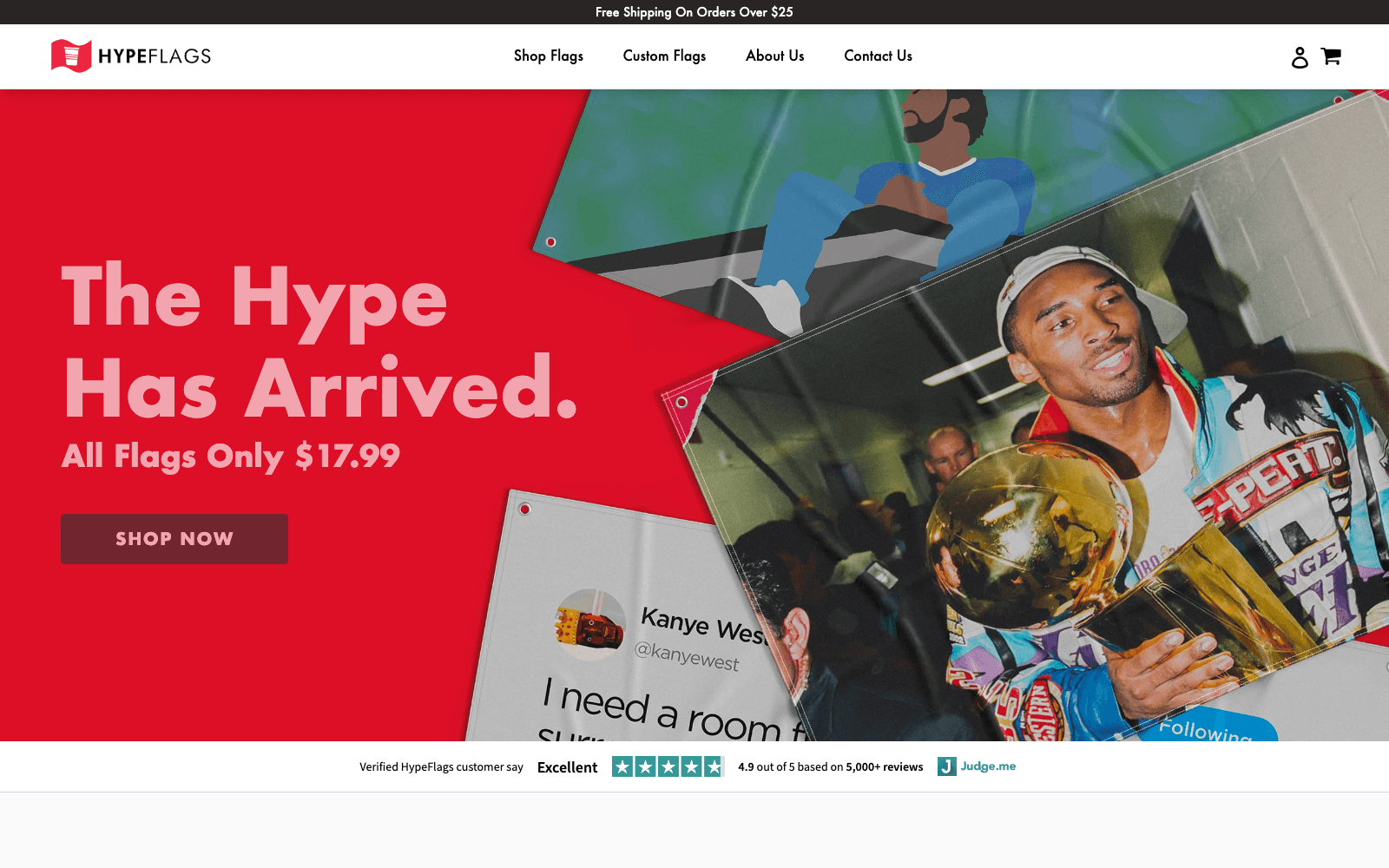
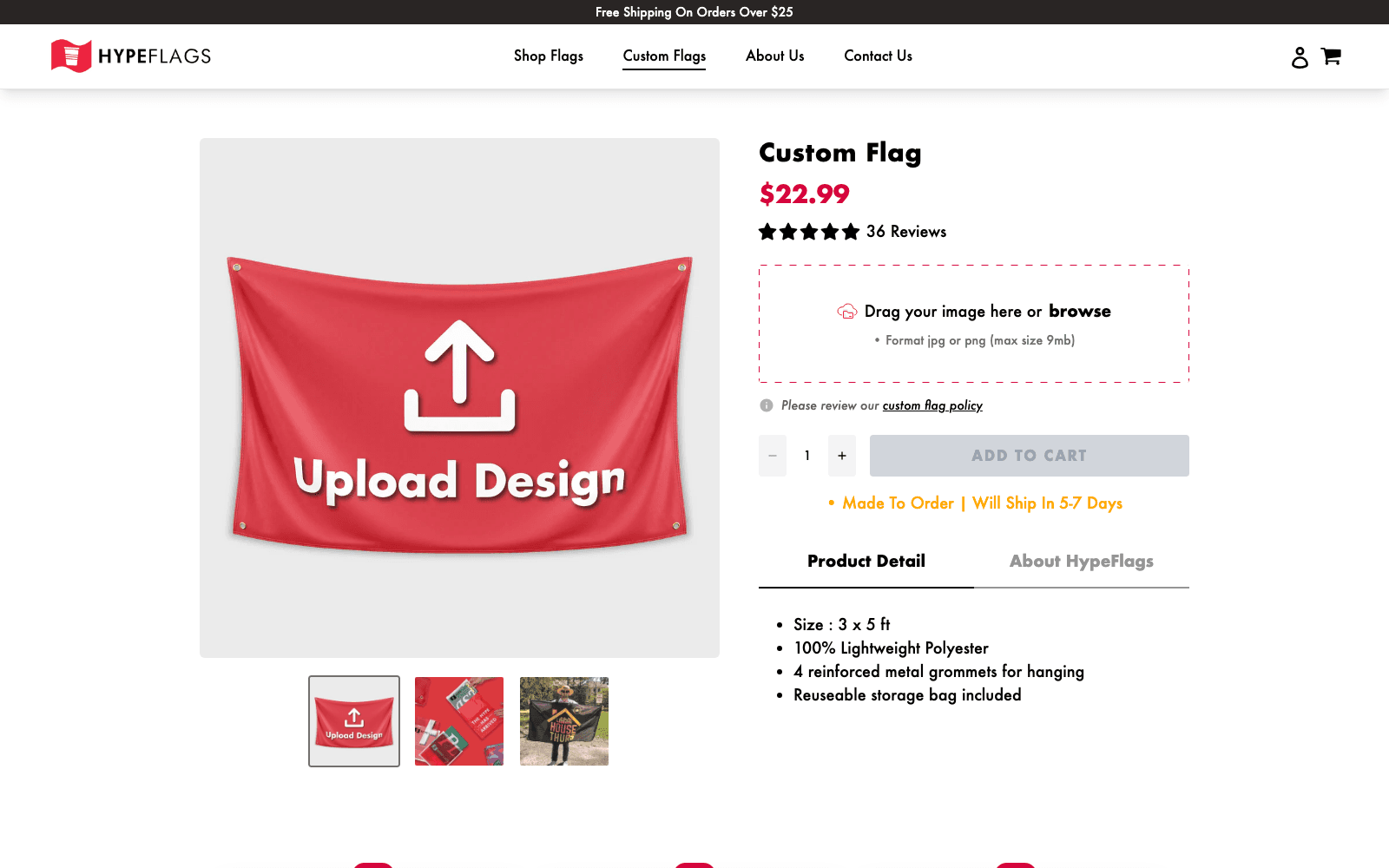
decisions that mattered
A brand identity, not a reskin
HypeFlags started on a default Shopify theme — functional, anonymous, and indistinguishable from a thousand other stores. The brand sells irreverent college-dorm culture, and the storefront had to feel like it. I rebuilt the theme into an identity of its own: layout, typography, product presentation, and the social-proof surfaces (reviews, customer photos) that a young, Instagram-native audience actually checks before buying.
A flag designer built into Shopify itself
The store’s core promise is custom flags, and there was no real tooling behind it. Off-the-shelf product customizers mean monthly fees, someone else’s UX, and lock-in — so I built the designer from scratch inside the store: customers upload a photo, crop and adjust it, preview the flag, and confirm the design. The artwork flows through the cart into the order, so fulfillment receives exactly what the customer approved. It runs as part of the storefront, not as a rented add-on.
Paste a tweet, get a flag
The second designer turned a novelty idea into a product line: paste any Twitter/X post URL into an input, and the store renders that tweet as a printable flag — light or dark mode, with further customization on top. Fetching and rendering arbitrary tweets into clean, print-ready layouts inside a Shopify storefront was its own engineering project, and it gave the brand a product no competitor offered.
Deleting the app tax
Like most growing Shopify stores, HypeFlags had accumulated third-party apps — one for free-shipping banners, one for discount promotions, and more — each billing every month for a feature a developer can build once. I replaced them with custom functionality inside the store: fully configurable by the owner, styled to the brand instead of to the app vendor’s widget, and costing nothing after the day they shipped.
A private backend for custom orders
A store built on customer-uploaded artwork needs more than a storefront — it needs an operations pipeline. I built HypeFlags a private order-management system that listens to Shopify’s order webhooks: when a custom-flag order completes, the uploaded artwork lands in a secure internal dashboard where the production team downloads the high-resolution original for printing. The same system streamlines customer communication — if an image is blurry, distorted, or too low-resolution to print, the team can email the customer about it directly from the order, before a bad flag ever ships.
An upsell that lives inside checkout
I designed and built a mystery-product upsell directly into the checkout flow: at the right moment, the customer is offered a discounted mystery product they can add to the cart in one tap — no detour to a product page, no third-party upsell app. It was pure store logic, and it worked: customers liked the mechanic, and it became a meaningful driver of upsell revenue.
anatomy of a custom order
Everything below the storefront was custom-built — from the designer to the private backend the production team works in. This is the path a single custom flag travels:
Design
Customer uploads artwork, adjusts it, and previews their flag in the in-store designer.
Checkout
A discounted mystery product is offered inside the flow — one tap adds it to the cart.
Webhook
Order completion fires a Shopify webhook to the private order-management backend.
Dashboard
The order and its artwork land in a secure internal dashboard for the team.
Quality check
Blurry or low-res artwork? The team emails the customer directly from the order — before printing.
Print & ship
The high-resolution original is downloaded and turned into the physical flag.
what shipped
Custom flag designer — upload, crop, customize, and preview in-store
Tweet-to-flag generator with light/dark variants and customization
Full theme rebuild and brand identity on top of Shopify
Custom promo, discount, and shipping-banner system replacing paid apps
Mystery-product upsell built into the checkout flow
Webhook-driven order-management backend for custom artwork
Customer-communication flow for artwork issues, tied to orders
Performance and responsiveness overhaul across the storefront
Ongoing feature development as part of the core team
results
~13%
Sales boost
5,000+
Verified reviews
4.9/5
Average rating
$0
Monthly app fees
The store rework and the checkout upsell together boosted sales by around 13% — but the quietest result is the most telling: years after the engagement ended, the storefront, both designers, the order-management backend, and the checkout upsell are still running the business. Custom work that survives this long without a developer on retainer is the difference between code that demos well and code that was built to be owned.
in the client's words
Aditya did an awesome job with HypeFlags! He’s quick and really proficient with his skills. He helped us improve our store performance by providing custom solutions, which was the exact out-of-the-box approach we were looking for. We had a great time working with Aditya and getting HypeFlags to a stage where it is now! We look forward to working with him again with our other projects.
why this matters to you
HypeFlags is here because it proves a specific claim: I can take a live Shopify store and build the functionality its business actually depends on — product customizers, checkout logic, brand identity — directly into the store, instead of renting approximations of it from the app store.
If your store's growth depends on features no theme or app quite delivers — or you're paying monthly for a stack of widgets a developer could replace — that's the exact gap I fill.